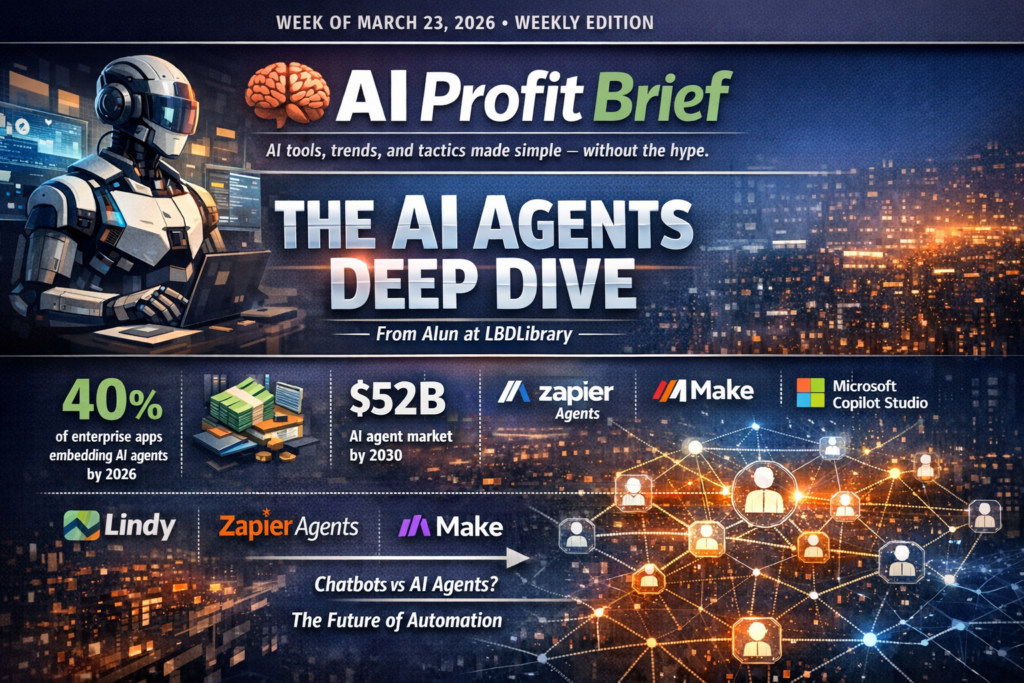

Hey 👋 You’ve been hearing about AI agents for months. This week, we’re cutting through the noise with a full deep dive — what they actually are, how they differ from the AI tools you’re already using, which platforms are worth your time, and where this is all heading.
No fluff. No hype. Just what you need to know to make a smart decision for your business. Let’s go.
By the numbers
What is an AI agent?
An AI agent doesn’t just answer questions. It does things.
A regular AI tool — like ChatGPT in a browser tab — responds when you ask it something. You type a prompt, it gives you an answer. You copy it, paste it somewhere, and carry on. The AI is reactive. You’re still doing most of the work.
An AI agent is different. You give it a goal — “qualify all new leads from our contact form and book meetings with the ones that fit our criteria” — and it figures out how to get there. It reads the form submissions, checks your CRM, sends personalised emails, monitors replies, and books calendar slots. It doesn’t wait for you to click “go” at each step. It plans, decides, and acts — across multiple tools — on its own.
Think of it less like a calculator and more like a capable new team member who works 24/7, never forgets a task, and follows your processes exactly as you’ve written them down.
Chatbot vs AI agent — what’s the difference?
| Traditional chatbot / AI tool | AI agent | |
|---|---|---|
| How it works | Responds to your prompt, one step at a time | Plans and executes a multi-step workflow autonomously |
| Who drives it | You — every step needs your input | The agent — you set the goal, it handles the rest |
| Tool access | Usually none — text in, text out | Connects to your apps and takes real actions in them |
| When it runs | Only when you open it and ask | Continuously, triggered by events or on a schedule |
| Best for | Drafting, answering questions, one-off tasks | Repeatable workflows, processes, operational tasks |
How businesses are using them right now
An agent reads new enquiries, scores them against your criteria, sends a tailored first response, logs everything to your CRM, and books calls with qualified leads — without you touching it.
Saves: 3–5 hrs/week
Reads your inbox, categorises emails by urgency and type, drafts replies in your tone, flags anything that needs a human decision, and archives the rest.
Saves: 1–2 hrs/day
Coordinates availability across multiple parties, books meetings, sends agendas, pulls relevant notes from your CRM before each call, and sends follow-up summaries after.
Saves: 45 min/meeting
Handles common support queries instantly, routes complex ones to the right team member, updates tickets automatically, and escalates anything that looks like a risk.
Handles: 60–80% of tickets
Pulls data from multiple sources on a schedule, compiles it into a structured report, highlights anomalies, and delivers it to your inbox or Slack — before you’ve had your coffee.
Saves: 2–3 hrs/week
Monitors outstanding invoices, sends polite follow-up emails at set intervals, flags overdue accounts, and updates your accounting software — no human chasing required.
Saves: 2 hrs/week
The platforms — what’s right for your business
Lindy
The top pick for small teams. Describe your workflow in plain English, connect your tools, and Lindy handles it. Agents can talk to each other — so a lead agent can pass a qualified contact straight to your scheduling agent. SOC 2 compliant. Free trial available.
Zapier Agents
If you’re already using Zapier, their agent layer adds AI reasoning to your existing automations. Best for simpler, trigger-based workflows. 7,000+ app connections. Less powerful for complex multi-step reasoning, but by far the easiest starting point.
Make (formerly Integromat)
Visual workflow builder with strong app-to-app automation. Great for teams who want to see exactly how data flows between systems. More setup required than Lindy, but very cost-effective and highly flexible once configured.
Relevance AI
Strongest for workflows that require AI reasoning on internal data — scoring leads, analysing documents, or running logic against your own datasets. Steeper learning curve than Lindy, but more powerful for data-heavy operations.
Microsoft Copilot Studio
If your team is already on Microsoft 365, Copilot Studio lets you build custom agents inside the ecosystem you already use. Tightly integrated with Teams, Outlook, SharePoint, and Power BI. Best for organisations that live in the Microsoft stack.
CrewAI / AutoGen / n8n
For teams with a developer on hand. Open-source frameworks that let you build fully custom multi-agent systems with complete control. Powerful, flexible, and free — but expect significant setup and maintenance time.
Gartner predicts over 40% of agentic AI projects will be cancelled by end of 2027 — not because the technology failed, but because businesses layered agents onto broken processes instead of redesigning them. An agent that automates a bad workflow just automates the problem faster. Before building an agent, document the process you want to automate as if you were training a new hire. If you can’t explain it clearly to a person, the agent won’t handle it reliably either.
Where this is heading
Single-task agents are mainstream. One agent handles one workflow — email triage, lead follow-up, scheduling. No-code platforms make this accessible to any business.
Multi-agent teams become standard. Specialised agents coordinate with each other — a sales agent hands off to a scheduling agent, which triggers a CRM agent, which alerts a finance agent. Gartner predicts one-third of agentic AI implementations will combine agents with different skills to handle complex tasks by 2027.
Week-long autonomous tasks arrive. In early 2024, AI models could sustain autonomous work for around four minutes. By February 2026, that had reached 14.5 hours — doubling every 123 days. At that rate, agents capable of running week-long projects without check-ins are coming fast.
AI intermediates B2B buying. Gartner predicts 90% of B2B purchasing will be AI agent intermediated by 2028, pushing over $15 trillion of spend through AI agent exchanges. Traditional SEO and PPC give way to “agent engine optimisation” — being findable and preferred by AI agents making buying decisions.
Agentic ecosystems at scale. IDC forecasts 45% of organisations will orchestrate AI agents at scale across business functions by 2030. The agent market is projected to exceed $52 billion. The divide between agent-ready and agent-unprepared businesses will be significant and difficult to close.
Quick hits
40% of G2000 job roles will involve working directly with AI agents by end of 2026, according to IDC — redefining entry, mid, and senior-level positions across industries.
McKinsey research shows businesses deploying AI agents in client-facing and admin workflows reduce operational overhead by 20–35% within six months — but only when they start with one well-documented process.
Goldman Sachs predicts companies will shift from human-centric staff to “human-orchestrated fleets of specialised multi-agent teams” — and that billing models will shift from hours to tokens consumed.
Salesforce research finds AI adoption among CIOs has surged 282% — but trust in data quality remains the number-one bottleneck stopping businesses from going fully agent-first.
This week’s tactic
Build your first agent this week — in under an hour
Don’t research. Don’t plan. Pick the one task in your business that you repeat most often and resent the most. Write it down as a numbered list of steps — exactly as you’d explain it to a new hire on their first day. Then open a free trial of Lindy or Zapier Agents, paste that list in, and connect two of your existing tools.
You don’t need it to be perfect. You need it to show you what’s possible. One working agent — even a rough one — will tell you more about where to go next than a month of reading about it. That’s the only move that matters this week.
That’s the AI agents deep dive. If you found this useful, forward it to one person in your network who keeps asking “but what actually are AI agents?” — this is the answer. 👊
See you next Monday,
Alun · LBDLibrary